Coping with Your Difficult Older Parent: A Guide for Stressed-Out Children
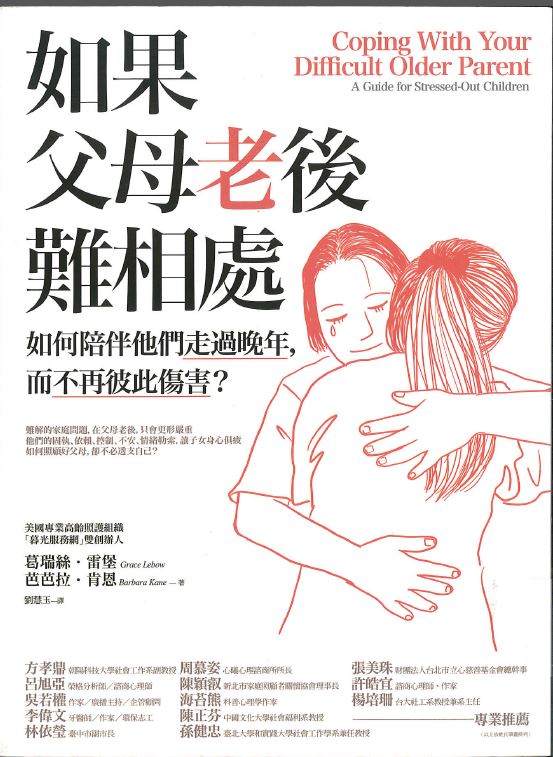
Book Title: Coping with Your Difficult Older Parent: A Guide for Stressed-Out Children (Chinese Edition: If Parents Become Difficult in Their Old Age: How to Accompany Them Through Their Later Years Without Hurting Each Other Anymore?)
Synopsis:
Intractable family issues only grow more severe as parents age.
Their stubbornness, dependency, control, anxiety, and emotional blackmail leave their children physically and mentally exhausted.
How can you take good care of your parents without overextending yourself?
★ A comprehensive look at 6 types of "difficult older parents."
★ The healthiest mindsets for accompaniment alongside the most practical advice for responding.
★ A classic masterpiece written by the founders of Aging Network Services, a professional geriatric care organization in the United States.
Listen to what these parents say; does it sound familiar?
"You have time to do this and that, so why don't you ever have time to care about me?"
"You're too busy to even pick up the phone? What's the point of having a daughter like you?"
"I gave everything for you, and what did I get in return?"
"If you try to send me to a nursing home, I might as well just die!"
"Your father left me behind and passed away first. What is the point of me living?"
Listen to the voices of these adult children; do you feel the same way?
"Every time the phone rings, I'm terrified it's my mother, calling to blame me for something I did wrong again."
"Every time I want to go abroad for a vacation, my mother 'just happens' to fall ill."
"My mother runs to the hospital and switches doctors all day long, yet her condition only seems to get worse."
"The older my father gets, the more stubborn he becomes. He finds fault with everyone, and everything has to be done his way."
"My parents' personalities have become so negative in their old age, and I'm so afraid that I will be influenced and become negative too."
"When facing difficult family members, no amount of SOPs will necessarily work. Sometimes, what your family needs is to be understood rather than to be fixed. This book provides a starting point for that 'understanding.'" — Matcha Bear (Popular Science Psychology Writer)
【The Dependent Parent】
• Cannot tolerate being alone; expects children to be with them constantly and be at their beck and call.
• Clings tightly to their children, relying on them to manage every aspect of life.
• Displays physical discomfort or obvious anxiety immediately upon separating from their children.
• Incapable of taking responsibility for their own decisions, relying entirely on their children to make choices for them.
【The Wet Blanket Parent (The Negative/Complaining Parent)】
• Speaks negatively, is full of grievances, and feels the whole world has wronged them.
• Extremely critical of others, yet entirely unable to handle criticism directed at themselves.
• Unreasonable, always demanding that others yield first.
• Suspicious, guarded, and sometimes paranoid to the point of obsession.
【The Narcissistic Parent】
• Only sees things from their own perspective, unable to understand the impact of their actions on others.
• Fluctuates between feeling superior to everyone and feeling inferior to others.
• Insensitive to the needs of others, yet considers themselves magnanimous and generous.
• Envious of other people's lives, unable to bear seeing others do well.
【The Controlling Parent】
• Manipulates their children using emotional blackmail techniques, such as generating guilt.
• Tolerates no challenges to their lifestyle, whether regarding daily trivialities or core values.
• Immediately retaliates if their children's responses do not meet expectations.
• Enjoys provoking a sense of helplessness in their children, which actually reflects their own inner powerlessness.
【The Self-Destructive Parent】
• Has a history of issues such as alcohol or drug addiction, or eating disorders.
• Has exhibited suicidal tendencies or threatened to do so.
• Has displayed certain compulsive behaviors, such as gambling or continuous hand-washing/cleaning.
• Uncooperative with medical treatment, refusing to follow dietary restrictions or take medications.
【The Fearful Parent】
• A habitual worrier who panics easily and worries constantly.
• Constantly claims to feel physically unwell, which may be real or imagined.
• Harbors many inexplicable fears, such as a fear of crowds or germs.
• Refuses to face reality, dreading doctor visits out of fear that entering a hospital means never coming out again.
Your parents may have always been difficult, and things simply worsened in old age; alternatively, they may have become difficult and hard to communicate with later in life due to illness or widowhood. In any case, adult children must understand that older parents are exceptionally resistant to change because change threatens to destroy their lifelong ego defense mechanisms.
According to statistics from the American senior care organization "Aging Network Services," over 50% of adult children seeking professional care consultation experience anxiety over their difficult parents. The children's source of stress stems not only from the physical burden of caregiving, but also from the mental exhaustion of facing repeated irrational behavior. Many children, even those who left home early to live independently and maintain distance, find themselves forced to re-confront this relationship when their parents become frail with age.
This book fills a gap in elderly care research. While there are many excellent works on caregiving, books exploring the troublesome behaviors of parents are conspicuously lacking. Books on personality disorders are also abundant, but they mostly focus on treating the patients themselves, leaving little to no text on how bystanders can help—let alone focusing directly on the elderly population, since older individuals with personality disorders rarely seek treatment voluntarily.
As a responsible adult child, you must realize that the problem is not one-sided. If you focus solely on your parents' problematic behavior while ignoring the interactive dynamic between you, it will be very difficult to break free from the predicament. One of the functions of this book is to show you that this painful parent-child relationship can be improved by adjusting your coping mindset and communication patterns. It is also hoped that through this book, children can better understand the struggles and pain behind their parents' difficult behavior.
About the Authors
Grace Lebow & Barbara Kane
Both are clinical social workers with over thirty years of experience. In 1982, they co-founded Aging Network Services in Bethesda, Maryland—a nationwide care network designed to assist individual families in caring for their elderly relatives and to resolve the various issues brought about by family members living scattered across the country. They are the co-authors of Coping with Your Difficult Older Parent.
Aging Network Services Website: www.agingnetworkservices.com
About the Translator
Hui-Yu Liu
Holds an MBA from the University of California, Riverside. She has worked as a consultant for market research firms, including Kantar Worldpanel (UK) and A.C. Nielsen (US). Her translated works include The 55 Business Models That Will Change Your Business, Tangible Marketing, The Case of Needles, Six Thinking Hats, and Why the Danes Are So Creative, among dozens of others.