Appreciating the Humanities with the Masters: Seven Lessons for Future Doctors
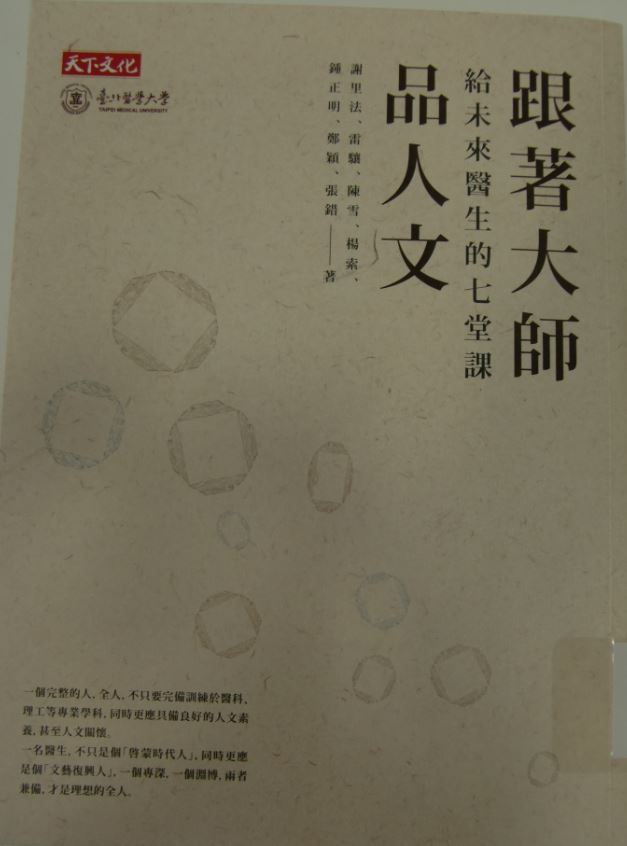
Book Title: Appreciating the Humanities with the Masters: Seven Lessons for Future Doctors
Book Description:
While professions can be chosen, the soul need not be confined. By appreciating the humanities and arts, the world you see will be transformed.
Literature and art originate from life, and in turn, nourish it. Guided by the interpretations of seven masters, even profound academic fields become accessible and enjoyable for both refined and popular tastes. As long as one understands the subtleties and exquisite details, art and aesthetics can be found everywhere in life.
Centered around lectures by renowned writers, Taipei Medical University organized a series of humanities seminars covering themes such as art and literature, literature and self-exploration, literature and history, science and the humanities, popular literature, and ritual culture. Though seemingly independent, these topics echo one another, demonstrating the integration and nourishment of art, literature, and life.
About the Authors:
-
Shieh Li-fa: Recreating the Golden Age of Taiwanese Artists
Art does not exist solely within the academy, Shieh Li-fa believes. He turns art into stories, using a literary touch to summon past artists and bring their brilliant lives before readers, re-enacting the Dadaocheng era—the most culturally vibrant and auspicious period in Taiwan.
-
Lei Hsiang: Our Stories, Their Lives
Everyone's life has extraordinary or memorable fragments, Lei Hsiang believes, and these fragments are the treasures that creators must capture and brew in their hearts.
Storytelling is Lei Hsiang's life faith. He displays the scenery in his eyes through words, images, and paintings, and with a devout heart, condenses his own life and the lives of others into stories that express the indescribable vicissitudes of human life.
-
Chen Xue: Knowing Yourself Through Lessons in Love
Chen Xue used to think that writing novels was the most important thing in her life, but in recent years she has deeply experienced that love is another focal point. She uses the stories of lovers she has deeply loved and hurt to search for and confront herself.
She believes that the most unusual thing in life is facing oneself. Although the process is painful, relationships are never permanently beautiful and brilliant; there are always ugly and difficult parts.
-
Yang Suo: Serenity in Bittersweetness, the Myriad Flavors of Life
Yang Suo's writing is plain and simple, yet it captures the most complex and intractable aspects of Taiwanese society. For her youth, food represented a source of income and family hardships. Now, it has become the memory and nourishment of her life.
Looking back on her life, she always finds it occupied by various flavors. Born into and having experienced deprivation, her impoverished youth nevertheless enabled her to insightfully perceive the beauty, ugliness, and conscience of human nature, leading her to believe in the days ahead that no matter the hardship, life always has a sweet aftertaste.
-
Cheng-Ming Chu: The Feathered Garment
Tiny stem cells not only affect the physical characteristics of organisms, but by regulating them, scientists hope to activate the body's regenerative mechanisms. Cheng-Ming Chu researches hair regeneration, hoping that like the Monkey King, he can constantly stimulate, transform, and functionalize stem cells. Furthermore, Chu transitions from human hair to bird feathers, which began a long evolution during the dinosaur era, growing increasingly complex. Viewing biological evolution through stem cells and then observing human aesthetics and cultural development yields unexpected resonances.
-
Cheng Ying: The Eternal Scholar's Dream of the Swordsman
Wuxia (martial arts) novels represent popular literature in the Chinese-speaking world, and their charm is boundless. In the world of martial arts, scholars are like spellbound readers, chasing soul-stirring dreams of chivalry.
Wuxia fiction is a unique element of Chinese-speaking regions and a treasure trove for creators seeking inspiration. Rich in Chinese culture, martial arts fiction offers a realm for creators to explore, where unbridled imagination and inspiration unfold through the wuxia world.
-
Chang Sung-Sheng (Dominic Cheung): Rituals Preserved in Vessels, Sustenance Aided by Utensils
Artifacts continuously connect different things deep within everyone's heart, from establishing hierarchy to consolidating status, and from remembering emotions to self-identity. Chang Sung-Sheng believes that artifacts are a long historical memory, containing the intellectuals' adherence to moral teachings, the rules by which noble families distinguish others, and the trauma brought by war. Ultimately, they implicate the imagination of various people and events in a grand era, forming an inseparable imagined community for researchers to explore, thereby appreciating China's ancient and elegant ritual culture.
-
Shieh Li-fa
Born in Dadaocheng in 1938, he graduated from the Department of Fine Arts at National Taiwan Normal University in 1959. He later traveled to France and the United States to study sculpture and printmaking. His creations focus on printmaking, exhibiting in many international print biennials, and his works are collected by the Museum of Modern Art (MoMA) in New York. Shieh is dedicated to researching and promoting local Taiwanese art. In 1978, he published The History of the Taiwanese Art Movement during the Japanese Occupation, a pioneering work in Taiwanese art history. He also attempts to combine art history with fiction, writing Purple Dadaocheng and The Changing Age. Recently, he published The Primary Colors of Dadaocheng: Shieh Li-fa on Himself.
-
Lei Hsiang
A writer, painter, and documentary filmmaker, Lei Hsiang has created works non-stop for nearly fifty years. He has authored thirty-five books, including essays, novels, short-short stories, illustrated albums, and photographic essays. His recent works include Glimpses of Floating Days: Lei Hsiang's Illustrated Album, Youthful Journey, and The Long Journey of Life. His works have won the China Times Literary Award Recommendation Prize, the Golden Tripod Award, the Golden Knight Award, the Golden Bell Award, and the Golden Tape Award. Both his writing and compositions are highly cinematic and evocative.
-
Chen Xue
Born in 1970, she graduated from the Department of Chinese Literature at National Central University. She focuses on fiction writing, with works including The Book of Bad Women, Butterfly, The Devil's Daughter, Love Hotel, Ghost Hand, The Child on the Bridge (winner of the China Times Open Book Best Book Award), The Possessed (nominated for the Taiwan Literature Award Golden Grand Prize, Taipei International Book Exhibition Prize Novel of the Year, and Golden Tripod Award), Lovers in the Labyrinth, Tai-妹 Times, and Skyscraper. Her short story "The Mark of the Butterfly" was adapted into the film Butterfly. Her essay collections include The Life Angels Love, Diary of a Wife, and Lessons in Love: Fifty Exercises for Lovers.
-
Yang Suo
Since childhood, she worked in many working-class jobs, including as a domestic helper and factory worker, but she was deeply fond of reading. She later entered the media industry as a reporter, consistently focusing on investigative reporting of working-class figures. She is the author of My Gambler Father and The Happiness of Evil.
-
Cheng-Ming Chu
An Academician of the Life Sciences Division at Academia Sinica and a Professor in the Department of Pathology at the University of Southern California, his expertise lies in stem cell science, embryology, and skin biology. After obtaining his Ph.D., he coincidentally ventured into feather research. In 2014, "The Origin of Birds" was selected by the journal Science as one of the top ten research breakthroughs. In recent years, he has engaged in hair follicle stem cell-related research. Chu also serves as the Honorary Chairman of the Developmental Biology and Regenerative Medicine Research Center at National Taiwan University, continuously promoting the development of regenerative medicine in Taiwan.
-
Cheng Ying
Born in Penghu, Taiwan, in 1969. She graduated from the Literary Creation Section of the Department of Chinese Literature and completed her Ph.D. in the Graduate Institute of Chinese Literature at Chinese Culture University. She currently teaches at Chinese Culture University. She is the author of The Wild Academy: A Study of Gao Yang and The Face of Melancholy: A Study of Li Yu's Fiction.
-
Chang Sung-Sheng (Dominic Cheung)
Pen name Chang Cuo, he is a contemporary poet originally from Huiyang, Guangdong (Hakka heritage). He received his Bachelor's degree from the Department of Western Languages at National Chengchi University, his Master's degree from the Department of English at Brigham Young University, and his Ph.D. in Comparative Literature from the University of Washington in Seattle. He is currently a Professor in the Department of East Asian Languages and Cultures and the Department of Comparative Literature at the University of Southern California. He has won the China Times Literary Award (First Prize for Narrative Poetry), the National Literary and Art Award, and the Chung Hsing Literary and Art Award. He has published over forty works, including seventeen poetry collections. His recent books include Mountain Dwelling Map and The Face of the Bronze Mirror.
