Overhauling Healthcare
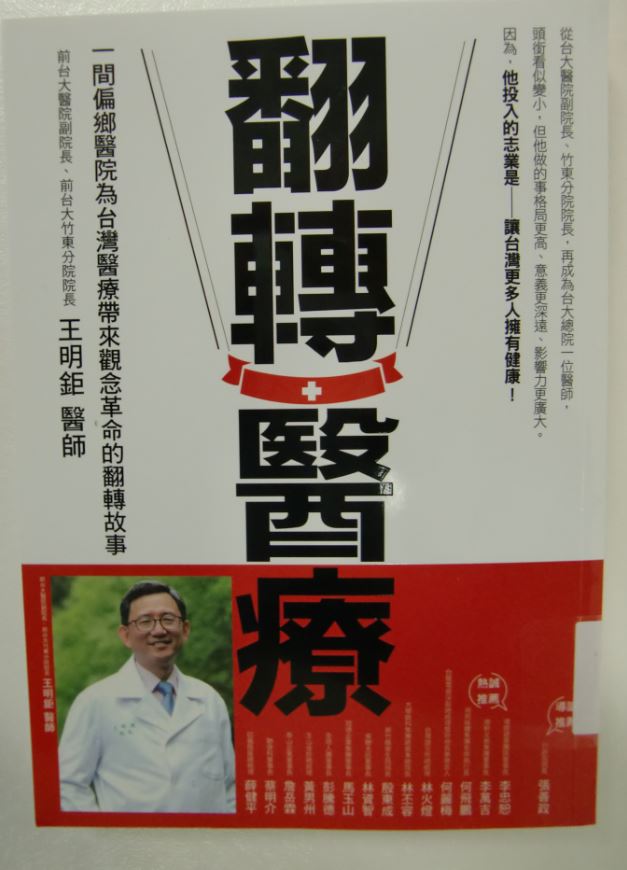
Book Title: Overhauling Healthcare
Book Synopsis:
From Vice Superintendent of NTU Hospital and Superintendent of its Chutung Branch, back to a regular physician at the Main Hospital—his title may seem smaller, but the vision of his work is grander, its meaning more profound, and its impact far-reaching. For his life's calling is to ensure that more people in Taiwan enjoy good health!
During his five-year tenure as Vice Superintendent of National Taiwan University Hospital (NTU Hospital) from 2008 to 2013, the author, Dr. Ming-Jiue Wang, integrated a collaborative care model for cardiology and cardiovascular surgery with innovative thinking, successfully creating a patient-centered cardiovascular center. He also established automated blood-testing systems for outpatient and emergency departments. These pioneering efforts dedicated to optimizing medical quality earned Dr. Wang the prestigious Medical Paradigm Award in 2015.
His accolades do not stop there. During his two years as Superintendent of the NTU Hospital Chutung Branch (2013–2015), he completely transformed a regional hospital that was barely scraping by on government subsidies. From upgrading hardware facilities to injecting a leadership style that wins hearts and minds, he importantly discovered a business model that focuses not on profiting from people's "illnesses," but on caring for and promoting their "wellness." Dr. Wang's story in Chutung is like "growing flowers on concrete"—and seeing them bloom everywhere. His transfer to Chutung served as a catalyst, prompting him to reflect on the value of regional hospitals and their operational direction. In the process, he systematically pinpointed the core issues plaguing Taiwan's current healthcare system and National Health Insurance (NHI) program, proposing practical, actionable strategies to "overhaul healthcare" and halt the ongoing collapse.
The book begins with the 700-plus days of Dr. Wang's tenure after being transferred to the Chutung Branch. "Superintendent, can you find a way to raise funds for a medical vehicle?" A single question from a driver changed everything. From that moment on, Dr. Wang took on this "mission impossible," giving lectures everywhere, communicating his vision, and actively fundraising. He continuously reflected on and adjusted his direction, overcoming one challenge after another to chart a sustainable path for the hospital. Within just two years, he completed a massive hospital-wide overhaul and established the "East Health Center." He aggressively promoted affordable, high-end health screenings focused on stroke prevention, myocardial infarction, and early cancer detection, which dramatically elevated the Chutung Branch's medical technology and service quality, highlighting the immense value of regional hospitals. His creative initiatives fostered deep cohesion among the entire medical staff, making everyone proud to serve at the Chutung Branch.
The author explicitly points out that while Taiwan's National Health Insurance system is hailed as world-class, it was fundamentally flawed in its original design. It ignored the differences between a small-country economy and a large-country economy, relying instead on the blood and sweat of overworked medical professionals to stay afloat. Flawed business models, the breakdown of the referral/hierarchical medical system, insurance turning into welfare, and a lack of cost-containment measures and incentives are the root causes of the NHI's systemic failures. Driven by public over-utilization and misplaced medical resources, the medical workforce has been exploited, NHI reimbursement rates remain low, the urban-rural gap continues to widen, and medical disputes persist—leaving the entire healthcare system on the brink of collapse.
While a myriad of problems loom before us, solutions are nowhere to be seen. In the near future, declining birthrates will further squeeze the supply of medical personnel, while a silver tsunami of an aging population hits, causing healthcare demands to surge. Is medical technology advanced enough to handle this crisis? Can the NHI survive by continuously raising premiums? The more critical question is: in a future with no staff, no money, and no hospital beds, where will the public's health stand?
If we do not reform the healthcare system that Taiwan was once proud of today, people will not be able to see a doctor in the future, no matter how much money they have. The author’s proposed solution lies in the reallocation of medical resources. Although the traditional hierarchical system cannot easily be restored to its original state, clinics, regional hospitals, district hospitals, and medical centers must have distinct missions. Only when each fulfills its specific role can medical burnout be alleviated, truly improving consultation and care quality. Preventing the waste of medical resources requires incentives; there must be mechanisms to "encourage lower utilization" and "discourage over-utilization" to foster genuine stewardship of precious medical resources. Instead of pouring the most funds and manpower solely into critical care, equal emphasis must be placed on preventive medicine and health management. This ensures that everyone can "stay healthy and avoid illness; if sick, suffer only minor ailments; prevent minor ailments from worsening; and prevent major illnesses from becoming fatal." Only then can Taiwan's NHI system be saved, and the public's health be secured. The book outlines eleven unique insights and practical approaches to "overhauling healthcare," offering a penetrating and thorough analysis.
Reading this book, readers will not only be moved by the author’s boundless passion for healthcare but will also gain a perspective that rises above the sensationalized healthcare news found in the press, media, and internet. With an objective and balanced view, readers will understand the flaws in Taiwan's healthcare policies, the mindsets that alienate the medical community from society, the improper medical-seeking habits of the public, and the urgent need to shift health paradigms. As citizens living on this land who benefit from and sustain the NHI system, every reader will be inspired to think about how to contribute to overhauling the future of Taiwan's healthcare—after all, we ourselves will be the ultimate beneficiaries of a healthy and happy life.
Book Features:
-
Written by an author with extensive medical expertise and hospital management experience, offering well-founded arguments and unique insights.
-
Examines issues from the differing perspectives of both doctors and patients, and from the standpoints of managers at both major medical centers and regional hospitals, deeply analyzing the root problems of Taiwan's medical system and proposing reforms to save it from collapse.
-
Introduces a 20-character health mantra: "Stay healthy and avoid illness; if sick, suffer only minor ailments; prevent minor ailments from worsening; and prevent major illnesses from becoming fatal," sparking a conceptual revolution.
-
Provides recommendations that empower every individual to make concrete improvements to their own health and to Taiwan's proud healthcare and insurance systems.
-
Written in an accessible and engaging narrative style that connects deeply with the general public through a passionate and moving dedication to the cause.
Celebrity Endorsements:
-
Introductory Recommendation:
Simon Chang (Chang San-cheng), Premier of the Executive Yuan
-
Enthusiastic Recommendations:
-
Ju-Shu Lee, Chairman of PYLAND Construction Group
-
Wan-Ji Lee, Chairman of Kang Hsuan Educational Publishing Group
-
Fei-Peng Ho, CEO of Cite Media Holding Group
-
Lora Ho, Senior Vice President, CFO, and Spokesperson of TSMC
-
Huo-Deng Lin, President of the Taiwan Stock Exchange
-
Pi-Jung Lin, CEO and President of Universal Eye Center Group
-
Tzu-Chih Lin, Chairman of ShareHope Medicine Co., Ltd.
-
Dong-Cheng Yin, Director-General of the Public Health Bureau of Hsinchu County Government
-
Yu-Shan Ma, Chairman of Kindom Enterprise Group
-
Teng-Te Peng, Chairman of TransGlobe Life Insurance
-
Nan-Chow Huang, President of E.SUN Financial Holding
-
Yue-Lin Zhan, Chairman of Taisun Enterprise
-
Ming-Kai Tsai, Chairman of MediaTek
-
Jian-Ping Xue, President of Sinyi Realty
-
About the Author:
Dr. Ming-Jiue Wang
Currently serves as a Professor in the Department of Anesthesiology at the National Taiwan University College of Medicine.
During his senior year at Taichung Municipal Taichung First Senior High School, the US terminated diplomatic relations with Taiwan; during his freshman year of college, the Formosa Incident occurred; the year he graduated from university, President Chiang Ching-kuo announced the lifting of martial law and the Democratic Progressive Party (DPP) was formed; the year he earned his PhD in Medicine, Taiwan held its first direct presidential election; and the year he graduated from the NTU EMBA program, President Ma Ying-jeou had just taken office.
He formerly served as the Special Assistant to the Superintendent of NTU Hospital, assisting in handling over 500 medical dispute cases within ten years. From 2005, he served as the Medical Secretary and CEO of the Quality Management Center at NTU Hospital. In October 2008, he became the Vice Superintendent and Director of the Planning Office at NTU Hospital, completing the post-fire reconstruction of the operating rooms within six months. He led the team to pass two Joint Commission International (JCI) accreditations, completed the renovation of the NTU Hospital Cardiovascular Center, and restructured the hospital's laboratory workflow. In August 2013, he was transferred to serve as the Superintendent of the NTU Hospital Chutung Branch. In May 2015, he founded the NTU East Health Center at the Chutung Branch and completed the full renovation of the entire Chutung Branch facility.
He possesses unique insights into medical quality management, hospital operations and management, and Taiwan's National Health Insurance system.
He frequently publishes articles on his personal Facebook page and boasts a substantial following!
His past accolades include: 2010 Manager Today Super MVP Manager; 2011 Taipei Medical Association Medical Exemplary Award (Xing-Lin Award); 2012 Top 5 CIOs across Taiwan, Hong Kong, and China; 2013 National Industrial Innovation Award – Entrepreneurial Innovation Model Pioneer Award by the Ministry of Economic Affairs; 2015 Medical Paradigm Award by the Taiwan Medical Association.
