Longevity Medicine Out of Control
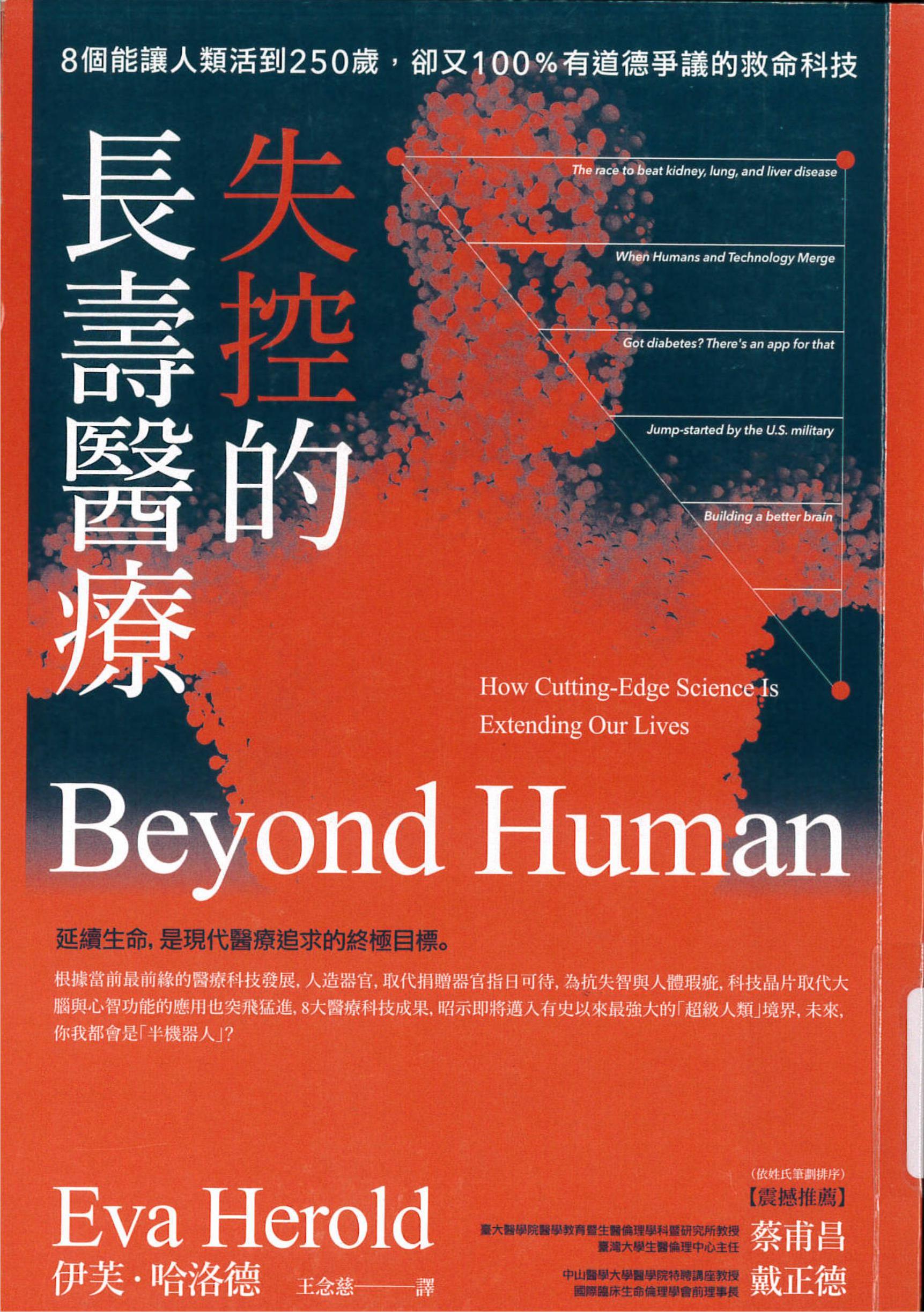
Book Title: Longevity Medicine Out of Control
Synopsis:
★ When sci-fi scenarios turn into popular science achievements ★
Extending life is the ultimate goal pursued by modern medicine.
According to the current forefront of medical technology development,
artificial organs replacing donated ones is just around the corner.
To combat dementia and human imperfections,
the application of microchips to replace brain and mental functions is also advancing by leaps and bounds.
Eight major medical technology achievements
herald our imminent entry into the most powerful "superhuman" realm ever seen.
In the future, will you and I both be "cyborgs"?
"Victor" is a person from the future.
He is already 250 years old but has the appearance of a 30-year-old and an artificial heart of a 50-year-old, which allows him to handle various strenuous exercises and even run marathons;
his type 2 diabetes has fully recovered, and his arm, lost in an accident, has been fitted with a prosthetic that functions exactly like his original arm...
But Victor’s life faces even more difficult problems:
● Many of his relatives and friends "oppose longevity medicine," waived their right to use these technologies, and passed away one after another, leaving him without companionship.
● He experiences a crisis of self-identity, not knowing whether he is ultimately "human" or a "machine," making it impossible for him to maintain "real relationships" with ordinary people.
● The long but lonely years make Victor desperately want to turn off the life-support devices that prevent his "natural death," but no doctor is willing to help him.
Although Victor's story sounds a bit like science fiction, in reality, we are indeed developing these life-saving technologies that extend longevity, some of which have even entered the clinical treatment stage. At the same time, however, they are 100% ethically controversial, for example:
■ The Invention of Total Artificial Hearts ► Patients can prolong their lives from now on without waiting for organ donations.
►► When artificial hearts become "consumables" and can be replaced indefinitely, can humans play God and live forever?
About 1,200 patients have used this artificial heart manufactured by the US company SynCardia; recently, the company successfully developed a smaller artificial heart aimed at "permanent therapy." This means that in the future, artificial hearts can be permanently implanted into the human body, saving patients who cannot wait for organ donations from death. However, the "heart" has been regarded as the seat of the soul since ancient times. Can a patient with an artificial heart still be called a human? Furthermore, in the past, "cardiac arrest" pronounced death. When artificial hearts become "consumables" and can be replaced indefinitely, will humanity achieve immortality?
■ "Brain Pacemakers" to Compensate for Memory Deficits ► Alzheimer's patients are saved.
►► Humans are expected to possess "super brains," but will the price be "mind control" by ill-intentioned individuals, depriving us of "free will"?
American neuroscientists have developed a "brain pacemaker" to attempt to treat patients in the early stages of Alzheimer's disease. This brain pacemaker primarily stimulates the hippocampus, which is responsible for managing memory in the brain, to reduce its degree of degeneration. However, they also worry that people with malicious intent might apply it to "normal people" to turn them into "super brains," making them invincible; or use it for "brainwashing," depriving humans of their most precious traits like "free will" and "independent thinking," making it easier for those in power to control and manipulate the masses.
■ "Mind Digitization" Technology is About to Come True ► Human mental activities are expected to be digitally exported and permanently preserved in computers.
■ If data is transferred to another medium, is it a clone? Is it "human" or a "machine"? Does it enjoy basic human rights as well?
With advancements in brain science, scientists predict that by the year 2050, humans will be able to download all memories, experiences, and thoughts from their brains into a powerful supercomputer for storage via a "brain-computer" interface system at the time of death. After the mind and personality of a dying person are copied into digital information, they can be transferred into a robot's body or used by others, allowing their consciousness to become "immortal." But is this clone "equal" to the person who was cloned? What is the difference between the two?
■ Cloud Medical Records, Telemedicine, and Emergency Care ► Saving more lives in real-time.
►► However, does this mean patients' right to privacy will be violated, or even risk being accessed by anyone?
In 2014, the University of Virginia developed an artificial pancreas combined with an app device, which can aggregate data such as patients' blood sugar to the cloud, allowing both doctors and patients to monitor blood sugar more accurately. Similarly, as long as personal medical histories and medication records are uploaded to the cloud, even if a patient is in an emergency with an altered state of consciousness, medical staff can read the medical record through the cloud to give the patient the most accurate medication and treatment. However, does this mean that patients' privacy will be arbitrarily exposed to the public, with the risk of being accessed by anyone without regulation?
■ Nano-Anti-Aging Drugs are About to Meet the Market ► Everyone can permanently maintain the health and appearance of a 25-year-old.
►► If people do not age, will it trigger class conflicts over "older adults holding onto existing resources," causing more social problems?
Our current imagination of old age mostly stays around gray hair and frailty. But suppose in 2030, a drug can allow people to maintain the health or appearance of a 25-year-old even if they are over 100 years old. Perhaps extreme longevity will hold greater appeal for ordinary people. However, at that time, it will inevitably trigger class conflicts over "older adults holding onto existing resources": young people will lose opportunities, and free reproduction might be restricted, thereby causing more social issues regarding equity, justice, human rights, and freedom.
This book leads us to examine the integrated technologies composed of programming algorithms, microelectronics, engineering, nanotechnology, cellular gene therapy, and robotics; these technologies are about to change our lives and even the state of society as a whole. The author, Herold, throws at us the difficult questions that scientists and bioethicists have been searching for answers to over the years: when the human body and brain become increasingly artificial, can we still maintain humanity, or will we eventually be manipulated by machines, unable to extricate ourselves. How humanity can properly utilize future top medical technologies under the "temptation of longevity technology" and the "justice of moral ethics" is well worth our careful consideration and reflection.
Book Features
(1) Includes the latest cutting-edge medical research, making it an excellent book for a glimpse into the trends of modern longevity medical technology.
(2) Provides real medical cases, presenting the current or potential ongoing medical ethical disputes realistically rather than as empty talk.
(3) In addition to acquiring the latest knowledge in medical technology, the author constantly raises questions, guiding readers into self-reflection.
Accolades and High Praise from Home and Abroad
"Inevitably, technologies are rapidly integrating under the manipulation of human ingenuity. In this book, Eve Herold reveals to us how these integrated technologies will affect our health and change humanity—hopefully for the better. By weaving in stories of patients using life-altering breakthrough therapies, Herold engagingly chronicles the development of technologies that are astoundingly enhancing humanity at this very moment." —— J.D., Executive Director of the Regenerative Medicine Foundation, Founder and Chairman of the World Stem Cell Summit / Bernard Siegel
"A brilliant review of technology, dazzling to the eyes." —— Kirkus Reviews, Featured Selection
"A great book that offers a glimpse into modern medical technology trends, not only leading readers to explore the consequences these technologies may bring to human society, but also stimulating public reflection on health and social sciences." —— Library Journal
"This book extends people's imagination regarding the impact that biomedical technology development will bring to human health and longevity, guiding readers to reflect on the importance of bioethics!" —— Professor, Department and Graduate Institute of Medical Education and Bioethics, NTU College of Medicine / Director, Center for Biomedical Ethics, National Taiwan University / Tsai Fu-chang
"Human Enhancement is currently a hot topic of research and debate in the medical and medical ethics communities. The dizzying, miraculous speed of technological progress forces us to carefully consider the issue of humans transcending their own limits. This book offers profound reflections from the interfaces of technology, medicine, ethics..." —— Distinguished Chair Professor, School of Medicine, Chung Shan Medical University / Former President of the International Association of Clinical Bioethics / Tai Cheng-te
About the Author
Eva Herold
Eva Herold is a science writer who specializes in discussing issues woven from science and society; she is also the former Director of the Office of Communications and Public Affairs at the American Psychiatric Association, and worked for a period at an organization for public policy research and genetic policy education. Herold has written and spoken extensively on topics related to stem cell research and regenerative medicine, as well as the social and bioethical dimensions of cutting-edge medical technologies. She is the author of books such as The Stem Cell Dilemma (tentative translation).
About the Translator
Wang Nien-tzu
With a passion for words and reading, she chose to take a turn in her life, stepping straight from academic clinical practice into a translator's life surrounded by words and new knowledge every day. She enjoys the translation life of learning by doing every day, and hopes to convey some positive energy through the power of words to make the world a better place.
