The Complete Muscle Vocabulary Guide (Based on Japanese original context: The Dictionary of Muscle Vocabulary)
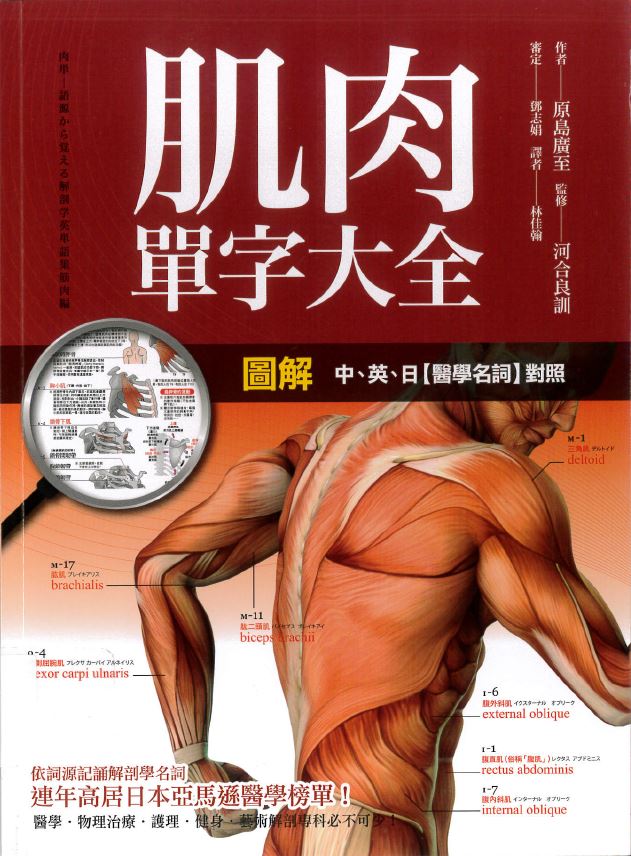
Book Title: The Complete Muscle Vocabulary Guide (Based on Japanese original context: The Dictionary of Muscle Vocabulary)
Synopsis:
~ Memorizing Anatomical Terms Through Etymology ~
★ Ranked No. 1 in Japan's medical book charts!
★ High on Amazon’s bestseller lists year after year!
★ Indispensable for specialists in medicine, massage therapy, nursing, fitness, and artistic anatomy!
★ Reviewed and approved by Dr. Zhi-Juan Deng, Ph.D. from the Graduate Institute of Basic Medical Sciences, National Cheng Kung University, and Associate Professor at Chang Gung University of Science and Technology.
◆◆ Memorizing Anatomical Vocabulary Through Etymology ◆◆
The Complete Anatomical Vocabulary Guide is the latest medical terminology manual published by Maple Book Publishing House. It utilizes diagrams to pinpoint the exact locations represented by technical terms and provides a trilingual comparison in Chinese, English, and Japanese. Today's international anatomical terminology is based on Latin, and the anatomical terms used in English are almost entirely derived from Greek and Latin. The text details the Latin, Greek, and other etymological roots of these nouns. Readers can use this to deduce the reasons behind the naming of technical terms and the connections between different words, alleviating the stress of having to memorize a vast amount of anatomical vocabulary right at the start.
◆◆ Illustrated Explanations of Muscles Across Five Major Body Regions ◆◆
The Complete Muscle Vocabulary Guide encompasses the technical terms for all major skeletal muscles, featuring clean and modern diagrams that allow readers to quickly grasp the shape and function of each muscle. It first introduces the primary muscles of the entire body before delving into detailed explanations for each individual muscle, categorized into 5 major sections: 【Overview, Head & Neck】, 【Trunk】, 【Upper Limbs】, 【Lower Limbs】, and 【Joints & Ligaments】. The book clearly marks the origin and insertion of each muscle. For the erector spinae muscle group, whose origin and insertion are difficult to understand using muscle shape diagrams alone, schematic models are paired for illustration. The text also strives to explain components that vary slightly across historical literature, making it easier for readers to categorize, compare, and summarize.
◆◆ A Reference Tool for Medical, Sports, and Art Professionals ◆◆
This series can serve as medical teaching material and is highly recommended for self-study among specialized students. It is an excellent reference book for professionals working in artistic anatomy, popular human science, clinical healthcare, fitness, and sports. Physical therapists, occupational therapists, osteopaths, and nursing personnel can all enhance their knowledge and techniques through this book.
Book Features:
◎ Interspersed with interesting anecdote columns: Etymological stories combined with 1,000 exquisite illustrations emphasize core concepts, facilitating the integration of theory with clinical practice while expanding the scope of knowledge.
◎ 3 ways to memorize anatomical terminology: 【Visual Memory ➜ Chinese Terms】, 【English & Japanese Memory ➜ Chinese Terms】, and 【Etymological Memory ➜ Chinese Terms】.
◎ Trilingual comparison across Chinese, English, and Japanese: The three languages connect 【Muscle Diagrams】 with 【Latin & Greek Etymological Explanations】 for mutual validation and cross-referencing, promoting rapid understanding and retention.
About the Author
Hiroshi Harashima
A multimedia editor, creator, and historical author. He is an ancient language enthusiast, a fossil and mineral collector, and a collector of postcards from the Meiji and Taisho eras. (Website: www.hrsh2.com)
