
The Malicious Doctor (Japanese: Akui)
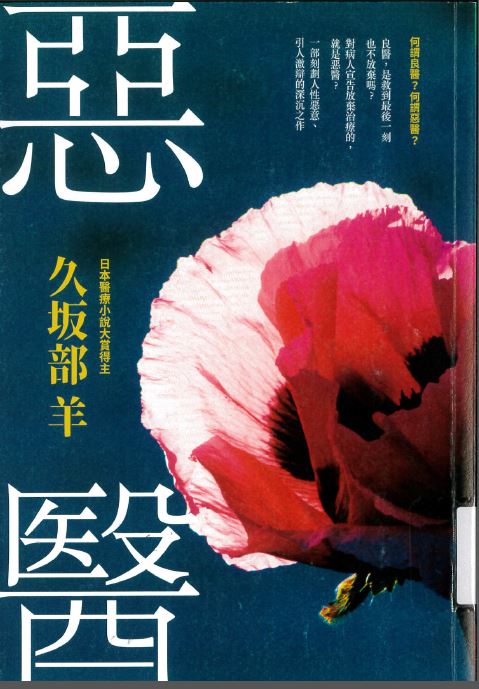
Book Title: The Malicious Doctor (Japanese: Akui)
Synopsis:
I want to pay tribute to the author. He portrays the respective agonies of cancer patients and conscientious physicians; today, no one else can capture such a contradiction. — Oncologist aiwakai
In your heart, what defines a good doctor? What defines a malicious doctor?
Is a good doctor one who rescues a patient until the very last moment without ever giving up?
Is a doctor who pronounces the discontinuation of treatment considered malicious?
The award-winning work of the Japan Medical Novel Award, The Malicious Doctor, takes you straight into the battleground of doctor-patient conflicts.
Given the increasingly deteriorating environment between doctors and patients in Taiwan, this is a must-read!
The 2014 winner of the Japan Medical Novel Award—Yo Kusakabe, employs a sharp writing style to deeply analyze the deeply entrenched ailments between doctors and patients within the medical system through a 5D perspective encompassing physicians, patients, family members, nurses, and social workers, unveiling a thought-provoking debate!
A patient with relapsed cancer & A physician exhausting his medical knowledge.
Between the patient's smear campaign and the physician's discontinuation of treatment, exactly "who is more malicious"?
This questioning persists until the final moments of destiny; it is a profound work that portrays the malice of human nature.
The greatest agony for a physician is watching the therapeutic measures in their hands turn into a sharp blade that cuts life short!
Morikawa, a 35-year-old surgeon: "As a physician, how can I perform harmful treatments on a patient? Patients for whom no treatment options remain should be told honestly; blinding oneself to reality and speaking comforting words is fundamentally a deception!"
The greatest fear in life is not death, but feeling right before the end that one has wasted their life away!
Konaka, a 52-year-old terminal stomach cancer patient: "The doctor said I only have three months to live and told me to make good use of my remaining time to do what I like; doesn't this advice plainly tell me to just go die?"
Like most people, even at the terminal stage of cancer, Konaka harbored the expectation that "treatment equals cure," always believing that as long as he "worked hard," there would be hope to keep living. When Dr. Morikawa declared that he had only 3 months of remaining life, he could hardly believe his eyes that the physician before him was telling him to stop treatment—"Go do some things you like," what kind of ghost advice was that? "It's basically asking someone to go die! No way, there must be another method!"
Later, Konaka met Dr. Tokunaga, who adopted a chemotherapy method of injecting Paclitaxel directly into the peritoneum. However, his physical strength deteriorated daily. Nurse Yoshitake secretly shared a secret with him, overturning Konaka's thoughts about treatment. Ultimately, will Konaka be able to find the good doctor of his dreams?
Facing the severe accusations from the terminal cancer patient Konaka, Morikawa was deeply distressed. He believed he had fulfilled his duties as a medical practitioner truthfully, yet it was misconstrued as an unethical "abandonment of treatment." Standing on a professional ground, if Konaka were to continue treatment, it could likely shorten his remaining life and cause physical agony. Facing such a patient, he truly felt bewildered and weary regarding the profession of saving lives.
Until one day, when he brushed past the Grim Reaper, he began to perceive death differently. However, would he still have the chance to share this realization with Konaka?
{Brilliant Quotes from the Book}
The Patient's Courage
Terminal stomach cancer patient · Konaka: "A doctor's attitude of never giving up and never abandoning us is also a form of encouragement. Only then can we summon our courage... the courage to face death."
Understanding Critically Ill Patients
The Doctor's Wife · Yoko: "Critically ill patients endure anxiety and fear, and among them, some become anxious or stubborn and willful due to illness. Adults in their prime have both work and family; death does not enter their minds, so they will absolutely strive for survival, hoping to be saved."
Life Is Like a Theme Park
Child A, knowing that the theme park has a closing time, rode all the attractions they wanted to try and toured various exhibitions very efficiently. Therefore, when it closed, they went home with a certain degree of satisfaction. However, Child B ran into the office to negotiate, and as a result, not only failed to ride the attractions they wanted, but also felt they had made an irremediable mistake—because they consumed all the time meant for amusement in bargaining.
The Psychological Preparedness of Helpers
Care Nurse · Chihiro Yoshitake: "It turns out that in my subconscious, I held expectations toward the patients—expecting them to be grateful, hoping patients would feel happy because of my care. Therefore, I could not accept those patients who refused to honestly display their happiness."
Ms. Inamoto from the Hercules Association: "Because you sincerely give to the patients, you expect a response all the more. This passion is vital, but do not let emotions sway you; you must remain calm at all times. Because if you do not think this way, your care can easily turn into a one-sided goodwill, which isn't of much help to the patient either."
Heavyweight Recommendations (Sorted by stroke count of surnames)
Acclaimed Reviews (Sorted by stroke count of surnames)
The greatest fear in life is not death, but feeling right before the end that one has wasted their life away! This book realistically describes the emotional transitions of a terminal cancer patient, as well as the conflicts triggered by the differing stances of doctors and patients, which is highly thought-provoking. — Cincia, Popular Anti-Cancer Blogger
This is a very unique novel. It initially unfolds parallel perspectives from two channels—the patient and the doctor—starting from an incident of doctor-patient conflict, and merges the viewpoints of both at the end of the story, thoroughly expressing the inner conflicts and struggles of both sides. It is truly a rare and excellent book for increasing mutual trust between doctors and patients. — Hui-Feng Hung, Deputy Director of the Department of Education and Research, Shin Kong Memorial Hospital
Whether struggling on one's deathbed or spending the remaining time well is more important, there might be no answer. It is enough to solely pursue your own heart, living as you desire, and leading a meaningful life for yourself. — Ting-Hua Ou, Admin of the fan page "This girl is sick"
About the Author
Yo Kusakabe
Born in 1955, graduated from the Osaka University School of Medicine, currently a physician and writer. He formerly served as a medical officer for the Ministry of Foreign Affairs of Japan, stationed overseas for 9 years. After returning to Japan, he engaged in home-based medical care for the elderly.
In 2003, he made his debut in the literary world with The Discarded Body.
In 2004, Rupture vividly depicted the reality of university-affiliated hospitals, drawing substantial attention for deeply excavating the ultimate solution to a super-aged society. His other works include Painless, The Hand of God, Denunciation, Number Five, Autonomy of Life (co-authored with Jinko Nakamura), Medical Illusions: 'Paranoia' Kills Patients, and Celebrating Funerals.
Among them, Painless was adapted into the 2015 Japanese drama The Magnetic Eye, starring Hidetoshi Nishijima.
One Day, You Will Encounter It Too was his first novel published in Taiwan.
The Malicious Doctor won the 2014 Japan Medical Novel Award.
-
Shang-Ju Yu, Chairman of the Taiwan Association for Hospital at Home / Director of Dulan Clinic
-
Chia-Hsuan Wu, Adjunct Attending Physician at the Department of Oncology, NTU Hospital / Specialist in Psychiatry
-
Cincia, Popular Anti-Cancer Blogger
-
Wen-Je Ko, Mayor of Taipei City
-
Hui-Feng Hung, Deputy Director of the Department of Education and Research, Shin Kong Memorial Hospital
-
Sheng-Chien Huang, Superintendent General of Taipei City Hospital
-
Yu-Xin Yang, Honorary Advisor to the Legislative Yuan / CEO of the Patient Autonomy Research Center
-
Ting-Hua Ou, Admin of the fan page "This girl is sick"
